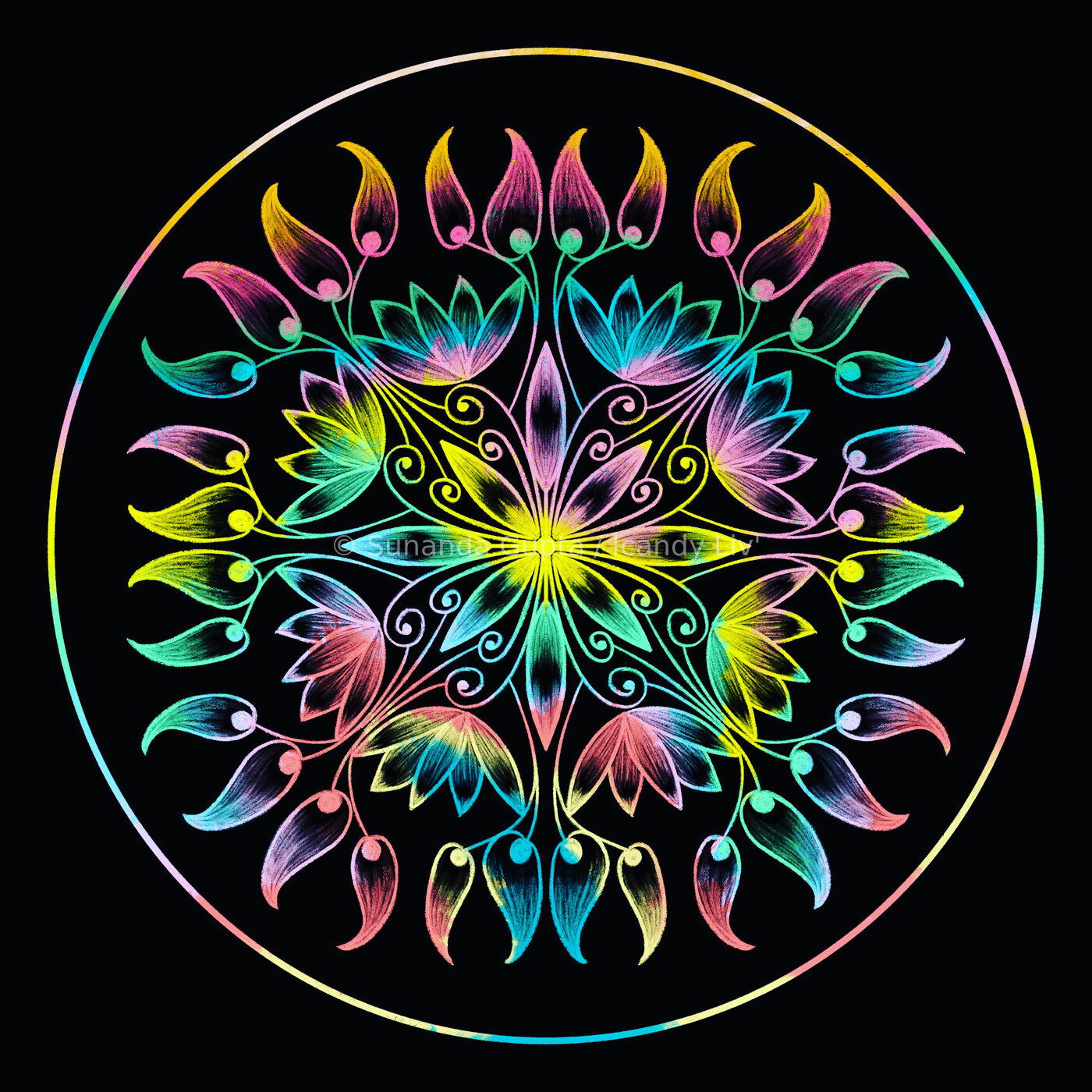
I rarely sit down with a colour plan. I know some artists do, they pick a palette before they even start drawing, they test combinations, they think about theory. I respect that approach, but it has never felt natural to me. For me, colour usually arrives as a feeling rather than a decision.
This Rainbow Bloom mandala is a good example. I knew I wanted it to feel joyful, almost electric. I wanted it to look like something you might see in a dream — flowers that glow rather than simply sit on the page. So I started with the centre, picked a yellow, and let each petal pull the next colour out of the one before it. By the time I reached the outer ring, the whole spectrum had arrived on its own.
Why black is the most important colour I use
Most of my digital work sits on a black background, and people sometimes find that surprising. They expect bright, colourful art to sit on white. But black does something nothing else can. It makes every other colour louder. A yellow petal on a white background is pretty. The same yellow on black feels like it is lit from within.
I discovered this early on, almost by accident. I was working on a piece and flipped the background, not expecting much. The whole painting changed completely. What had looked soft and decorative suddenly looked alive. I have barely used a white background since.
Learning to trust what the piece asks for
The hardest lesson I have learned as an artist is that you do not always know what a piece wants to be when you start it. You have to keep going and let it show you. Colour is the clearest example of this for me. There have been pieces where I was convinced I wanted a warm palette, reds and golds, and halfway through, the work asked for teal and pink instead. When I listened, it worked. When I pushed through with my original idea, it usually did not.
That is not to say there is no skill in colour choices. There is a lot. You learn which combinations vibrate and which ones fight each other. You learn when a tiny pop of an unexpected colour saves a whole composition. But the learning happens mostly in the doing, not in the planning. At least, that is how it works for me.
Colour is the part of making art that still surprises me every time. I hope it always does.